
PALMYRA · PROCESS & QUALITY
From palmyra sap to industrial ingredient.
Botanical identity, controlled processing and measurable release criteria. A technical guide to palmyra palm sugar for food manufacturers, professional kitchens and import teams.
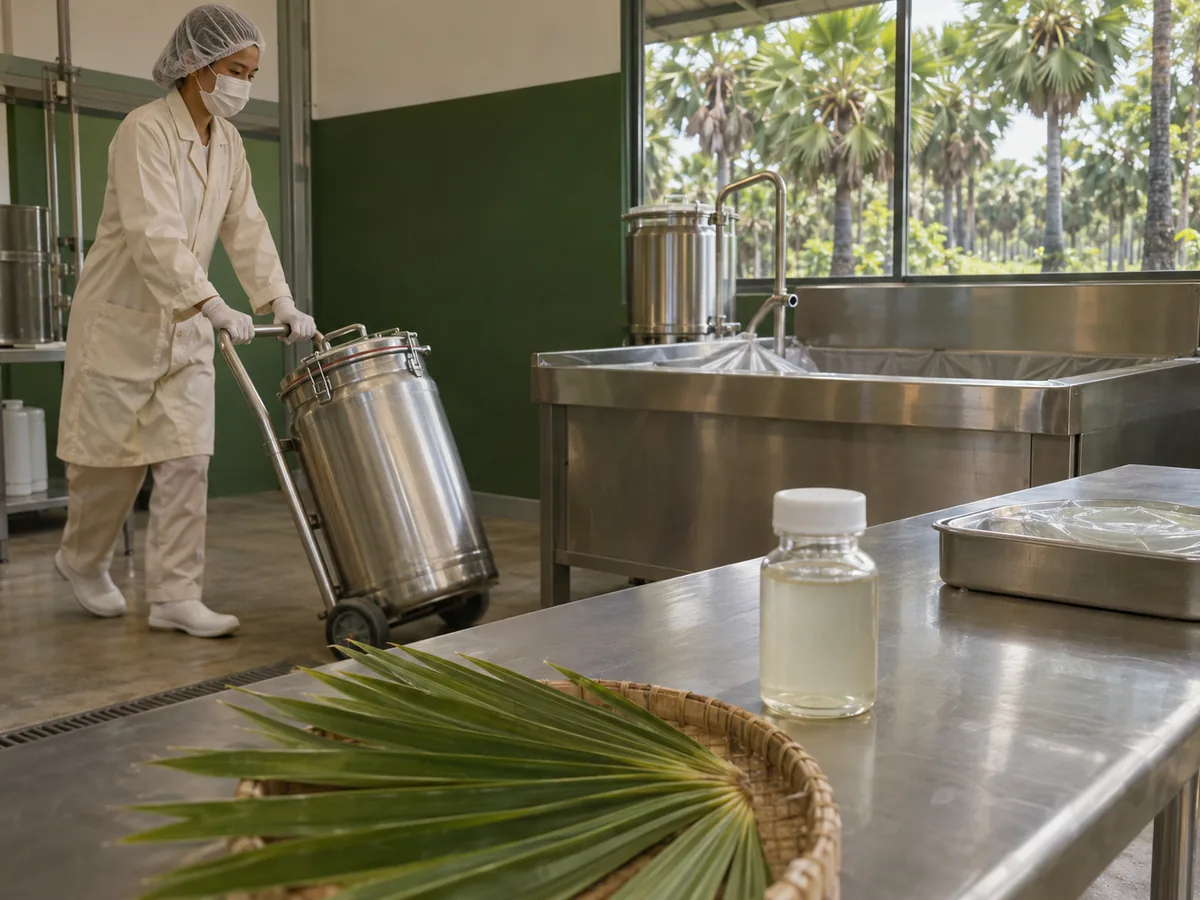
Raw material & receipt
Identify the palm. Trace the lot.
Palmyra sugar originates in the flower-stalk sap of Borassus flabellifer, rather than palmyra fruit or coconut sap. For a dry product declared 100% palmyra sugar, check the formula, supplier declaration and relevant processing aids. Link the received material to production and packing lots so identity can be followed through the supply chain.
Crystals and powder: 100% palmyra palm sugar. Golden Taan syrup: palmyra sugar and mineral water, a separate formula.
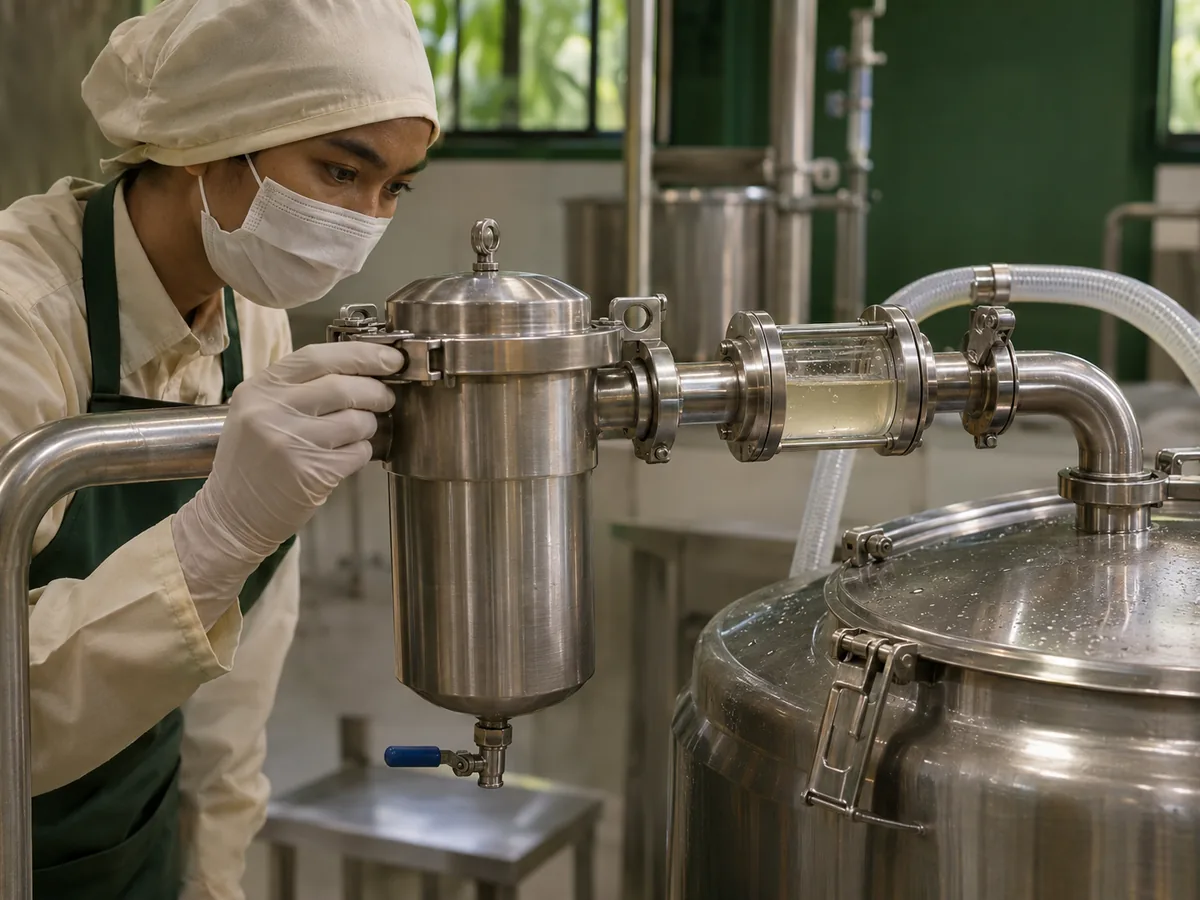
Sap handling & filtration
Protect the sap before concentration.
Palmyra-specific storage research shows that temperature affects fermentation and sugar composition. Receipt controls should therefore include time, temperature and raw-material condition against assessed criteria. Filtration separates suspended material; it does not by itself demonstrate microbial inactivation.
- Document receipt
- Record sap source, collection/receipt time, temperature and defined checks such as pH or soluble solids.
- Verify filtration
- Specify filter type/size, integrity checks, cleaning and replacement frequency.
- Prevent recontamination
- Separate raw-material routes from product after control steps and use suitable food-contact equipment.
Controlled concentration
Manage water removal. Preserve product character.
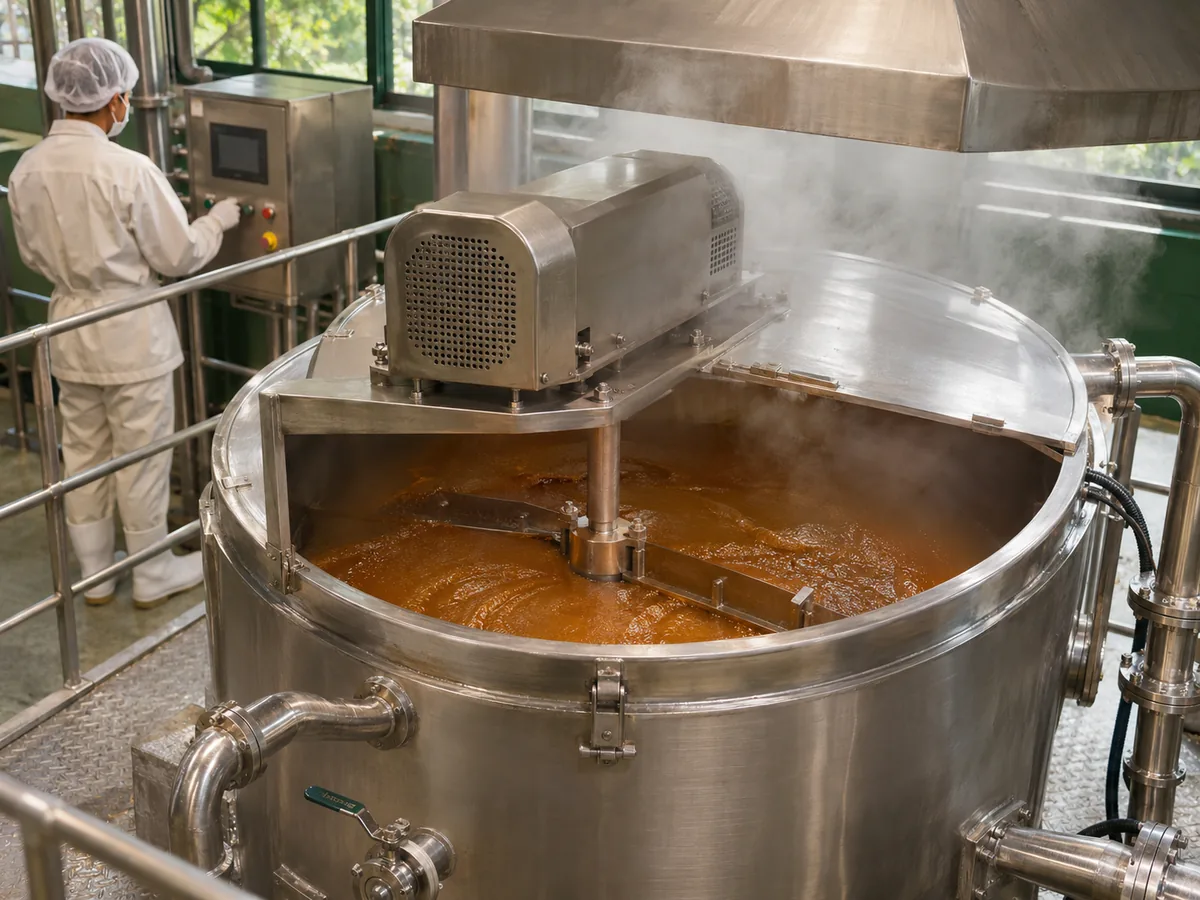
Experimental work on palmyra sugar and syrup compares different concentration and drying conditions and their effects on product characteristics. Industrial scale-up needs a defined endpoint for each format, backed by operating records. Color or apparent thickness alone is an incomplete endpoint.
Operating conditions
Time, temperature, agitation and pressure where vacuum is used must correspond to the actual equipment.
Process endpoint
Select soluble-solids or moisture criteria by format, with a sampling method and reference temperature.
Food safety
Microbial reduction steps and critical control points require operation-specific hazard analysis and validation.
Drying & size grading
Specify the texture for the production task.
Dry-format routes can involve cooling, agitation, drying, milling and sieving according to the desired product. Specify particle-size distribution and bulk density for dosing, blending and filling. A larger pack does not physically shrink the grains of the same grade; they simply look smaller relative to the pack.
Crystals
For dissolving in sauces and broths or a specified textured finish. Agree grain-size bands and fines content to suit the application.
Request sieve distribution, moisture and bulk density, then trial dissolution in the actual recipe.
Choose your form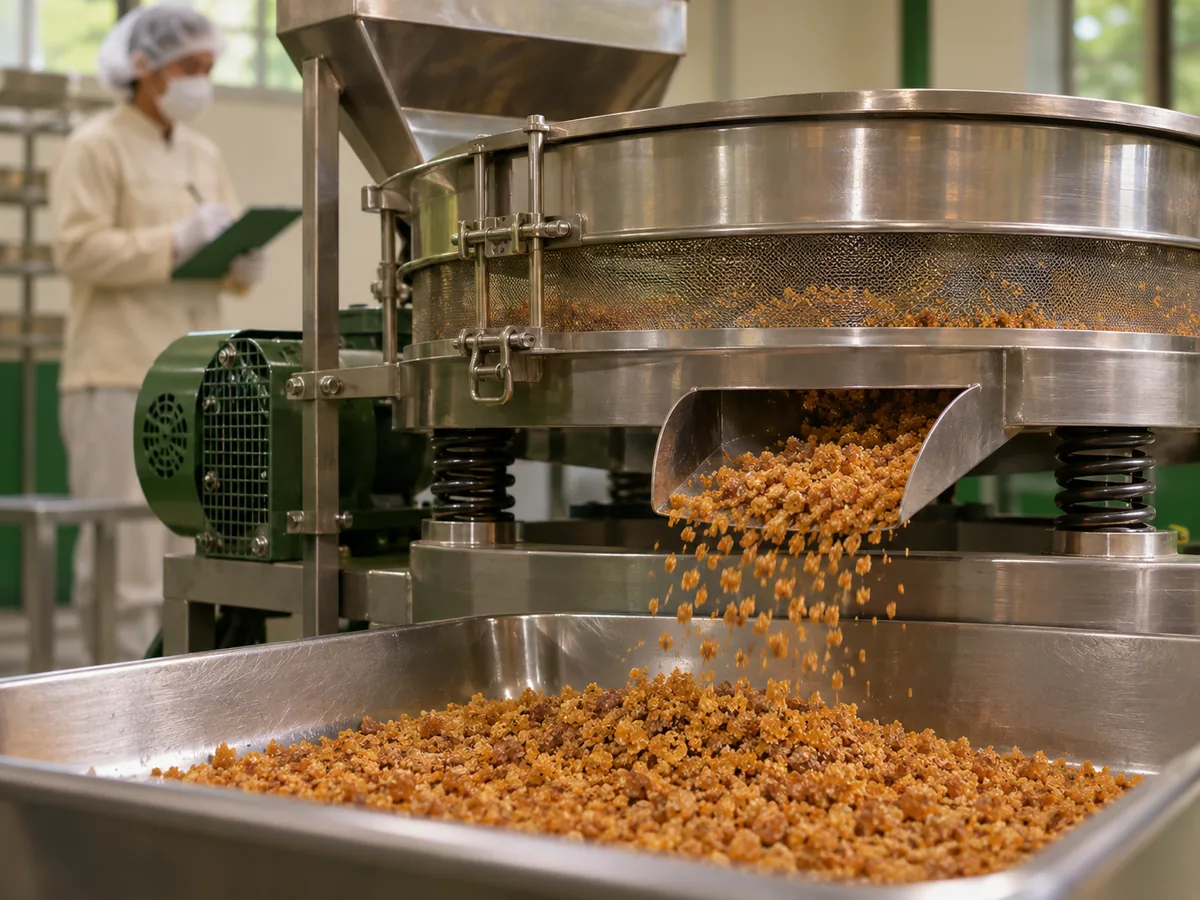
Protective packaging
Keep the specification through distribution.
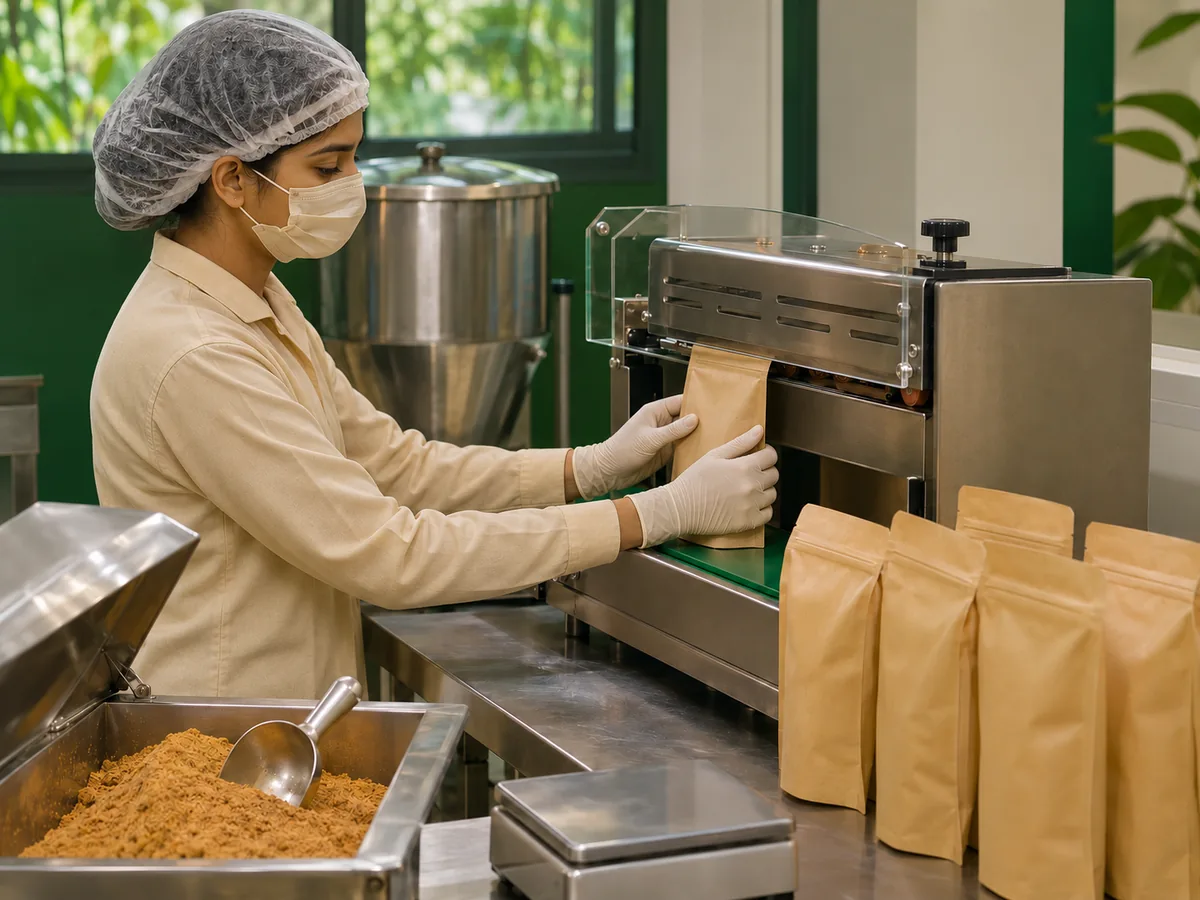
For dry sugar, assess moisture barrier, seal integrity and storage conditions together. A paper food pouch needs evaluation of its actual food-contact liner and barrier structure. Syrup requires a separate assessment of formula, filling process, closure compatibility and microbiological control.
Choose your formMaterial identity for formulation
| Sweetener | Origin | What to consider in the kitchen |
|---|---|---|
| Palmyra palm sugar | Sap from palmyra flower stalks | Caramel-like/toasted character and color vary with processing. |
| Coconut sugar | Sap from coconut flower stalks | A different plant; some flavor notes may overlap. Taste the actual batch. |
| Refined white sugar | Usually cane or sugar beet, then refined | Useful for sweetness with little added color or aroma. |
| Cane brown sugar | Cane products with a molasses component | Molasses character and moisture depend on the product. |
Testing & batch release
Turn quality into verifiable records.
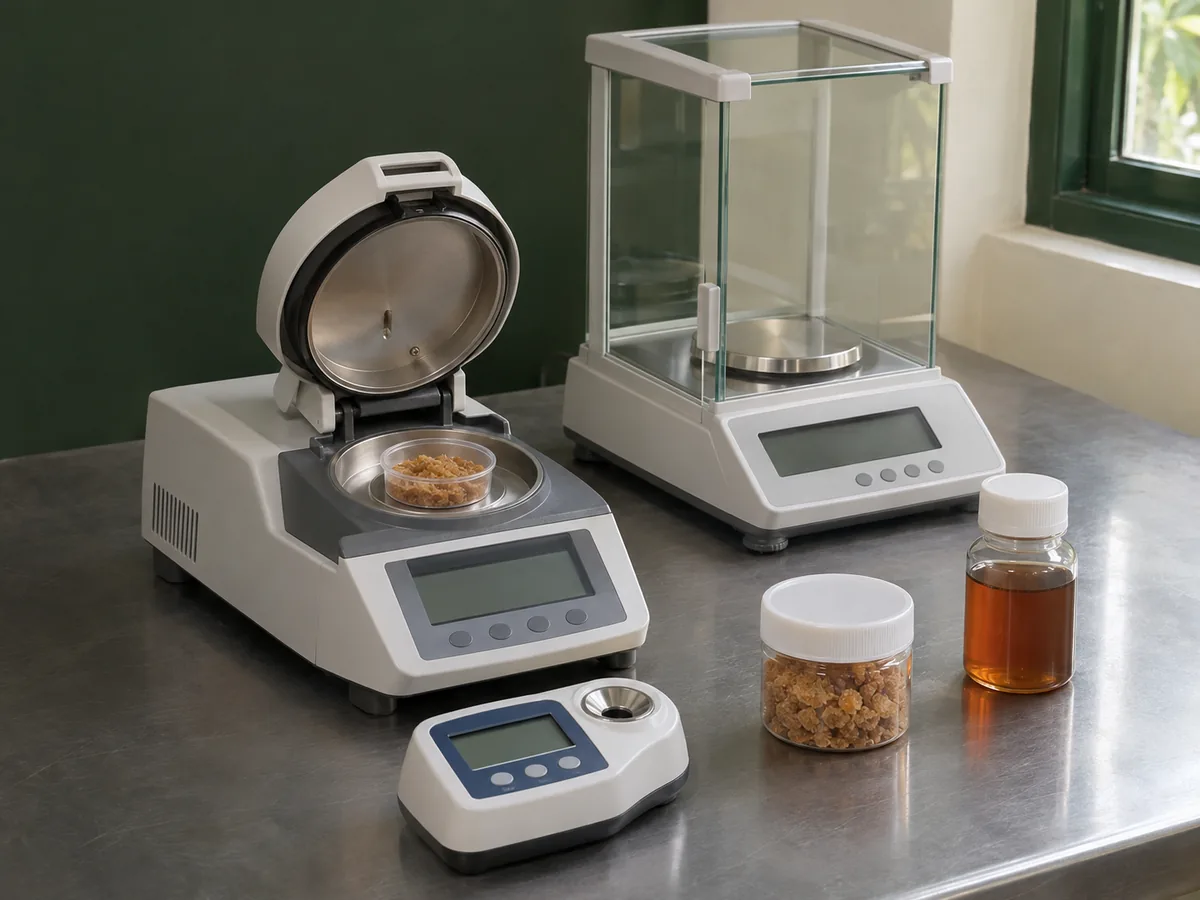
A product specification sets acceptance criteria; a certificate of analysis reports the tests actually performed for a lot. Include units, methods, lot identity, dates and approval status. Release decisions should consider test results alongside process records and deviations, rather than a single measurement.
Read the specification before comparing numbers
°Brix
A refractive estimate of soluble solids, referenced to sucrose solutions.
Not automatically purity or total-sugar percentage. State method and temperature.
Moisture
Water content of a sample, reported with its test method.
Different from water activity; not a standalone shelf-life prediction.
Water activity · a_w
A temperature-dependent measure relevant to food stability.
Measure it directly. Do not infer it from moisture or photographs, or use it to establish every aspect of safety.
Particle size & bulk density
Grain-size distribution and mass per filled volume.
Useful for sieving, dosing and container selection. Specify sieve method and packing condition.
pH & microbiology
Results depend on product, sample preparation and test method.
Use acceptance criteria appropriate to the product and market, rather than borrowing another brand’s results.
Sugar profile & identity
Sucrose, glucose and fructose results, using a suitable method such as chromatography, need units and a wet/dry reporting basis.
Combine analysis with supplier verification and traceability. For adulteration questions, ask the laboratory for a method fit for that specific purpose.
Color & HMF
Instrumental color and, where agreed, HMF can support characterization and assessment of heat history.
State product-specific methods and criteria. Color is not purity, and limits for a different food cannot simply be transferred.
Supplier qualification document pack
- Grade-specific specification, actual formula, raw-material identity and relevant processing aids.
- Process flow and hazard-control summary, including validation of important control steps.
- Lot-linked COA and laboratory reports with methods, units and laboratory identity.
- Food-contact documentation, packaging structure and seal verification.
- Shelf-life evidence and storage instructions covering agreed distribution and use.
- Traceability, retained samples and a product-recall plan.
- Actual-formula nutrition, labels and destination-market documents.
- Certificates with verifiable holder, scope and validity.
BORASSUS FLABELLIFER · RESEARCH
Research the ingredient. Check the formulation.
Use flower-sap and sugar studies on Borassus flabellifer. Coconut sugar, palmyra fruit-pulp powder and carrier-containing powders are different materials.
Sap handling and fermentation
A palmyra-sap storage experiment compared ambient and refrigerated conditions. It supports assessment of holding time and temperature, rather than a finished-product shelf-life claim.
Drying and sugar characteristics
A granulated-palmyra study compared drying–solidification conditions, followed by milling and sieving. It illustrates process development, not a universal machine operating recipe.
Read the powder formula first
A sap-powder brownie study used carriers and an in-vitro GI estimate. It cannot substantiate a single-ingredient sugar formula or Golden Taan’s GI.
Control points follow the hazard analysis.
The examples below are an assessment framework, not an automatic list of CCPs. Identify hazards, evidence-based limits, monitoring, corrective action and verification for the actual facility.
Illustrative manufacturing control review
| Issue | Control approach | Records to assess |
|---|---|---|
| Sap holding | Assessed holding time, temperature and intake criteria | Source, acceptance checks and time records |
| After microbial reduction | Zoning, hygiene and suitable equipment | Risk-based cleaning and verification |
| Foreign material | Filters, sieves and metal detection where justified by hazard analysis | Integrity/effectiveness checks and nonconforming-product handling |
| Moisture and seals | Barrier structure, sealing conditions and storage | Packaging, seal and shelf-life verification |
| Batch release | Review specification, tests and deviations | COA, lot approval and traceability |
THAILAND · UAE · INTERNATIONAL
Industrial quality and export requirements
A recommended framework for producers and buyers targeting the UAE and other markets. Each element serves a different purpose; one certificate does not replace all destination requirements.
Production foundation
GMP / GHP + HACCP
Check the relevant Thai FDA manufacturing requirements, including GMP 420 where applicable. Good hygiene provides the foundation for process-specific hazard analysis.
International buyer target
FSSC 22000
Recommended for assessment when targeting international retail chains or food manufacturers. It combines ISO 22000, sector prerequisite programmes and additional FSSC requirements; it is not a universal UAE import requirement.
UAE market entry
Product registration + Arabic labels
The appropriately licensed importer should confirm product registration and label assessment with the destination authority before shipment. Check formula, net contents, nutrition, dates and consignment documentation.
Market-specific assurance
Halal
Assess ingredients, processing aids, operations and buyer requirements. For UAE halal certification, check the recognition and scope of the certification body with MOIAT. The Halal National Mark is optional and is distinct from other import documentation.
This is a standards and document-selection guide, not a claim that Golden Taan holds every certificate listed. Confirm the holder, scope, number and validity of the documents applicable to an order.
Questions from procurement and quality teams
Is every palmyra powder a 100% sugar formula?
Check the actual ingredients. Some drying studies use carriers such as maltodextrin or inulin, so their formulations cannot represent a single-ingredient product.
Does low moisture mean sterile?
No. Dry conditions may restrict growth while some microorganisms survive. Hygiene and prevention of recontamination remain important.
Can a research temperature become a production limit directly?
No. Validate it for the raw material, equipment, scale and hazard being controlled. Research is a development reference, not Golden Taan’s SOP or batch-release limit.